
Study Examines California’s Biosolids Capacity Under Potential Land Application Restrictions
The “Biosolids Capacity Challenges from a Land Application Ban in California” study examined a practical and increasingly important question: If California banned or severely restricted land application, including both direct application of biosolids and application of biosolids-derived products such as compost, where would those materials go, and what would the change mean for wastewater agencies, ratepayers, farmers, and the state's climate goals?
Prepared by Brown and Caldwell and Carollo Engineers, the study used 2024 data from the U.S. EPA, Bay Area Clean Water Agencies (BACWA), Clean Water SoCal, and CalRecycle to develop a statewide biosolids management inventory and evaluate potential effects on management capacity, costs, and greenhouse gas emissions. The findings indicated a substantial shortage of landfill and other non-land application capacity to manage biosolids currently beneficially used on land. Abruptly shifting away from these established beneficial uses would increase costs for utilities and ratepayers and greenhouse gas emissions. By evaluating this planning scenario, the study illustrated the scale of the challenge and the importance of preparing before policy changes occur.
California Depends on Beneficial Use
California generates approximately 3.5 million wet tons of biosolids each year. About 2.5 million wet tons, roughly 71 percent of the statewide total, are beneficially used through direct land application or land application of products such as compost in California and Arizona. Approximately 15 percent of California's biosolids, primarily from Southern California, are currently beneficially used in Arizona, adding an interstate dimension to California's biosolids landscape.
Land application recycles nutrients and organic matter, supports soil health and water retention, offsets some use of synthetic fertilizer, and provides carbon sequestration benefits. The study found that replacing this established management pathway would be difficult in both the near and long term.
Landfill Capacity Falls Short
The study found that California landfills would not have enough additional capacity to receive the 2.5 million wet tons of biosolids that could be displaced by a land application ban. Even under an optimistic scenario, one that assumed changes to Senate Bill 1383 and that all permitted Class II and Class III landfills would accept biosolids up to 5 percent of their total incoming waste, an estimated 1.46 million wet tons per year would still lack in-state capacity. That represents a 58 percent shortfall. Under a more conservative scenario, the shortfall could exceed 2.1 million wet tons per year, representing an 84 percent shortfall.
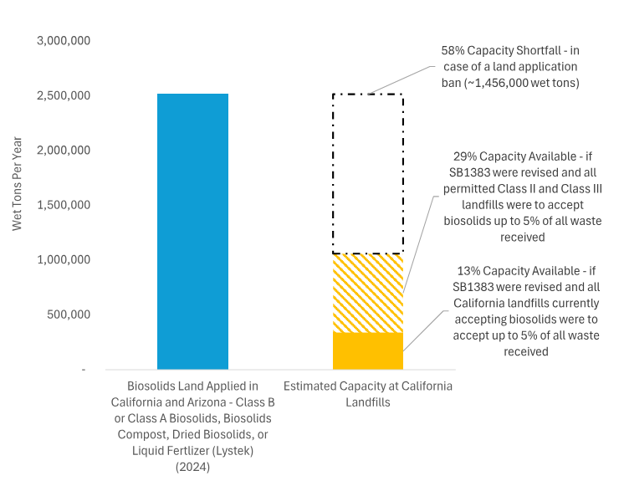
The study noted that these estimates may have overstated practical landfill availability. Biosolids are a high-moisture material, and landfill operators must manage stability, leachate, seasonal operating conditions, and the availability of dry material for blending. Some permitted landfills may choose not to accept biosolids at all.
Other technologies cannot currently replace land application at the scale required. California has one operating biosolids incinerator. Meanwhile, pyrolysis, deep-well injection, and other advanced treatment options have limited existing capacity and face cost, permitting, siting, and implementation constraints.
Potential Impacts on Affordability and Climate
The study estimated that shifting beneficially used biosolids to landfill disposal could increase annual biosolids management costs for wastewater utilities by approximately $140 million to $420 million. These costs would ultimately be borne by ratepayers. Farmers could also lose access to a locally available soil amendment and face greater reliance on manufactured fertilizer.
The analysis also identified significant climate impacts. Land application of biosolids sequesters carbon and avoids emissions, while landfilling biosolids generates methane and other greenhouse gas emissions. Replacing land application with landfill disposal was estimated to increase net greenhouse gas impacts by approximately 399,000 metric tons of carbon dioxide equivalent per year, a 174 percent increase, comparable to adding about 86,770 passenger vehicles to California roads each year.
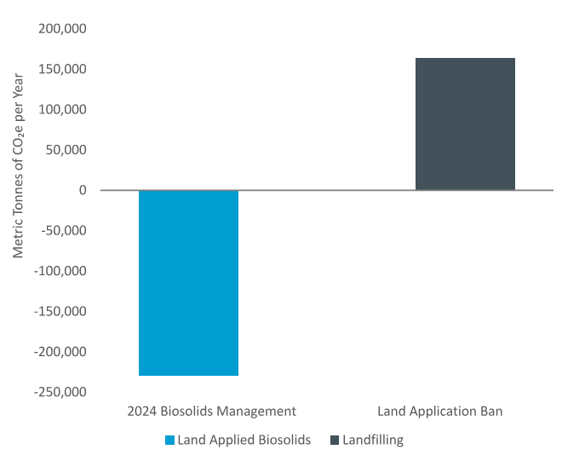
Increasing landfill disposal of biosolids would also conflict with California's SB 1383 organics diversion and methane reduction goals, along with other state policies supporting healthy soils, carbon sequestration, and beneficial reuse.
A Responsible Path Forward
The study recommended that California continue protecting public health and the environment while preserving sustainable and affordable biosolids management options. Key actions included:
Continuing source control and monitoring to reduce per- and polyfluoroalkyl substances (PFAS) before they reach wastewater treatment plants and biosolids.
Strengthening policies that address PFAS in commercial products and industrial processes.
Avoiding abrupt restrictions that eliminate beneficial use of biosolids before practical replacement capacity exists.
Investing in research, pilot projects, and technologies that reduce PFAS and expand reliable management options.
Aligning biosolids policy with California's climate, methane reduction, soil health, and regional resilience goals.
Resources for Wastewater Agencies
To support informed conversations about these issues, the study team has made the full report, a concise legislative handout, and a presentation deck available for wastewater agencies. These resources are meant to support wastewater agencies in their communications regulators, policymakers, governing boards, and other key stakeholders.
Full Report: Detailed data sources, assumptions, statewide inventory, and capacity, cost, and greenhouse gas analyses.
Legislative Handout: A concise two-page overview designed for legislative and policy audiences.
Presentation Deck (pdf): A ready-to-use visual summary of the study's findings and recommended path forward (PowerPoint file).
Wastewater agencies are encouraged to use these resources to support informed conversations about management capacity, affordability, environmental outcomes, and the importance of maintaining reliable beneficial use options while PFAS policies continue to evolve.