
Biosolids: A Sustainable Fertilizer Alternative
Since the Green Revolution in the mid-20th century, agriculture has relied on the extensive use of synthetic fertilizers to increase crop yields. This practice has been shown to have significant climate and environmental impacts. For example, the production of ammonia, one of the most used synthetic fertilizers, accounts for roughly 1% of global greenhouse gas emissions and 1% of global energy use. Research has shown that biosolids can support plant growth and offer an environmentally sustainable alternative to synthetic fertilizers.
Researchers from Mississippi State University conducted a field study in Fall 2015 to determine whether biosolids could match or exceed the performance of synthetic fertilizers in promoting plant growth and improving soil quality. By analyzing four different crops and comparing plant size, nutrient uptake, and soil conditions across different fertilizer treatments, the study sought to assess the viability of biosolids as a practical and eco-friendly fertilizer option. The case study findings suggest that, when properly processed and managed, biosolids from wastewater treatment processes can support soil health and plant growth, as well as or better than synthetic fertilizers.
Case Study
Overall Methodology
Researchers obtained Class A Exceptional Quality (EQ) biosolids (≥90% TS) from City of Clinton (Mississippi) Department of Public Works in September 2015. Fields were pre-bedded into rows and divided into experimental plots. Each experimental plot was transplanted with 10 plugs of one of four crops: dianthus, petunia, kale, and Swiss chard. Biosolids were then applied to plots at four different rates: 2, 8, 14, and 20 wet tons per acre. These were compared with experimental control plots treated with two different types of synthetic fertilizers: a slow-release fertilizer (Osmocote) or a conventional fertilizer (blend created to mimic the reported N-P-K ratio as the slow-release fertilizer). Both synthetic fertilizers were applied at 100 lb/acre N. The synthetic fertilizers and biosolids were applied by hand to the top of each row and incorporated into the soil with a commercial bed shaper/mulch layer.
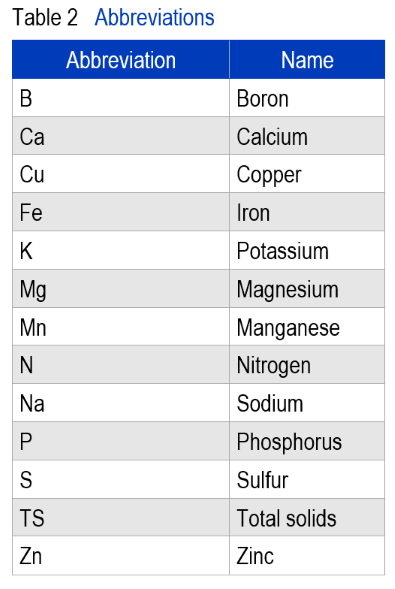
Over a two-month period, the researchers measured the impact of biosolids application rates on soil pH, organic matter, macronutrient levels (N, P, K, Ca, S, Mg), micronutrient levels (B, Cu, Fe, Mn, Na, Zn), plant size index (computed using width and height), flower production, and shoot dry weight. Results were collected at 43 and 56 days after transplanting. They also analyzed plant tissue to see how well nutrients were absorbed. The experiment was carefully designed to ensure reliable comparisons between treatments.
Results
The study found that biosolids improved soil organic matter and increased levels of nutrients like phosphorus, zinc, and sulfur, especially at higher application rates. Most crops showed similar growth and nutrient uptake compared to those treated with synthetic fertilizers. However, Swiss chard showed reduced growth at the highest biosolids application rate, possibly due to excess nutrients. Interestingly, flowering was most abundant in plots with the lowest biosolid rate (2 tons/acre), possibly due to nutrient deficiency triggering early blooming.
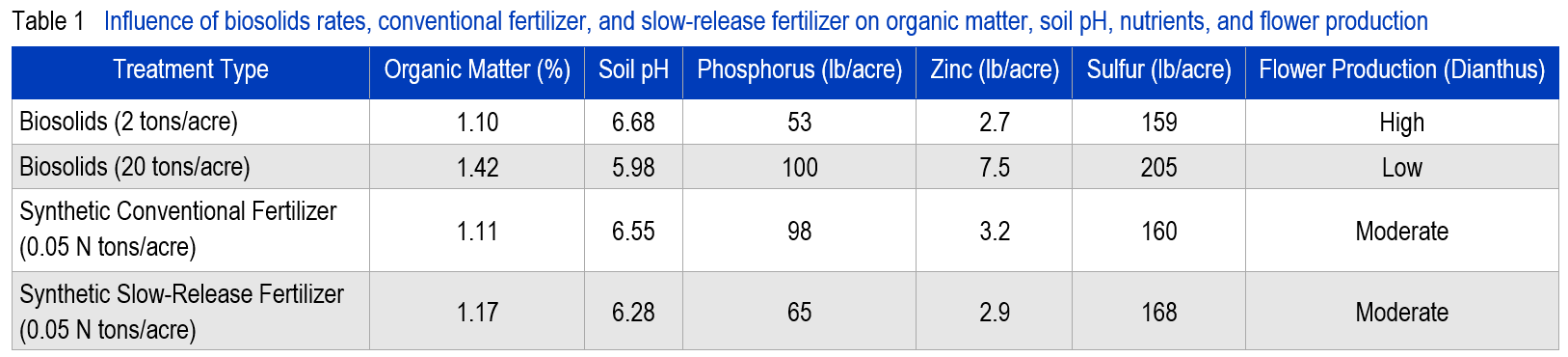
The researchers collected plant size measurements (plant size index formula is included in research article) to also compare these differences from varying biosolid application rates. No differences in plant size were detected in kale. However, in dianthus and Swiss chard, a reduction in size was observed for biosolids applied at 20 tons/acre. The research team hypothesized that toxic nutrients or salt levels were reached at this application rate for crops.
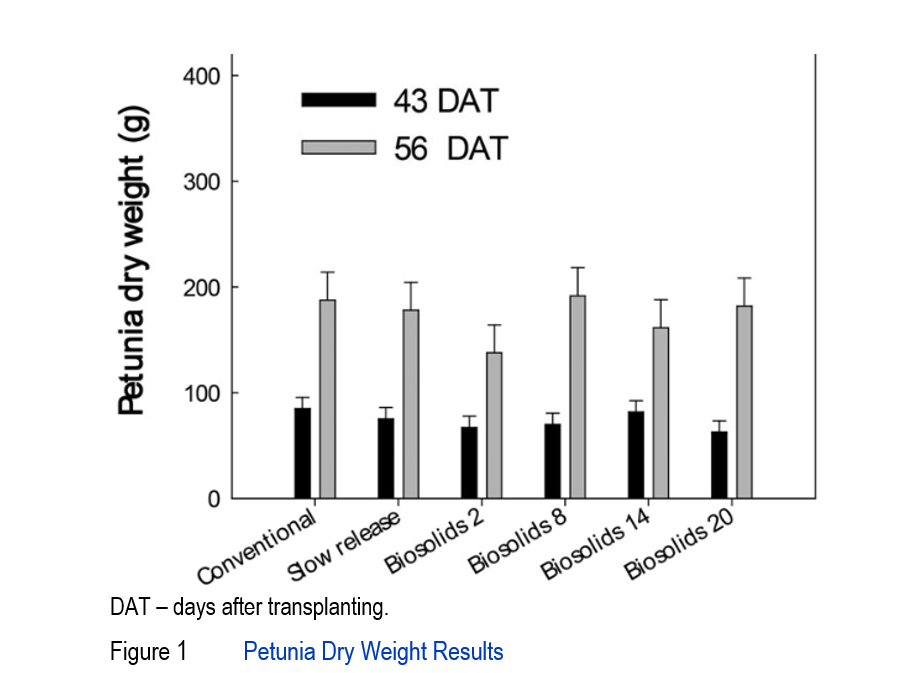
Additionally, plant shoot dry mass was measured. Except for Swiss chard, no differences in dry weight were observed for dianthus, kale, or petunia in comparison to the conventional and slow-release fertilizers, which suggests that farmers would likely be able to achieve comparable yields from biosolids as they would from fertilizers. Figure 1 shows the dry weight accumulation results for petunia. Swiss chard had a reduction in dry weight for all biosolids application rates compared to the conventional and slow-release fertilizer controls.
Conclusion
This study supports the idea that, in addition to being an environmentally beneficial way of recovering resources such as nutrients and carbon from the wastewater treatment process, biosolids can also be just as or more effective and beneficial than synthetic fertilizers. Biosolids offer benefits beyond those of synthetic fertilizers including improved soil structure, increased organic matter, and enhanced nutrient availability. This study also highlights the importance of appropriate biosolids land application practices, as both excessive and insufficient nutrient loads may lead to nutrient imbalances and plant stress. With proper management, biosolids can play a key role in reducing reliance on energy and greenhouse gas intensive synthetic fertilizers, while improving soil health and agricultural productivity.
Source:
Broderick, S.; Evans, W., (2017). Biosolids Promote Similar Plant Growth and Quality Responses as Conventional and Slow-release Fertilizers. American Society of Horticulture Science, Vol 27: Issue 6, 794-804. https://journals.ashs.org/view/journals/horttech/27/6/article-p794.xml